You saw the ad, and now you want to know whether Peptides Collective is legit before you hand over a card number. Short answer: we don’t call it a scam, because we have no regulator or court document alleging fraud by this seller. But its own pages say its peptides are sold only for laboratory research and are not for human use, and that matters more than anything in the ad.
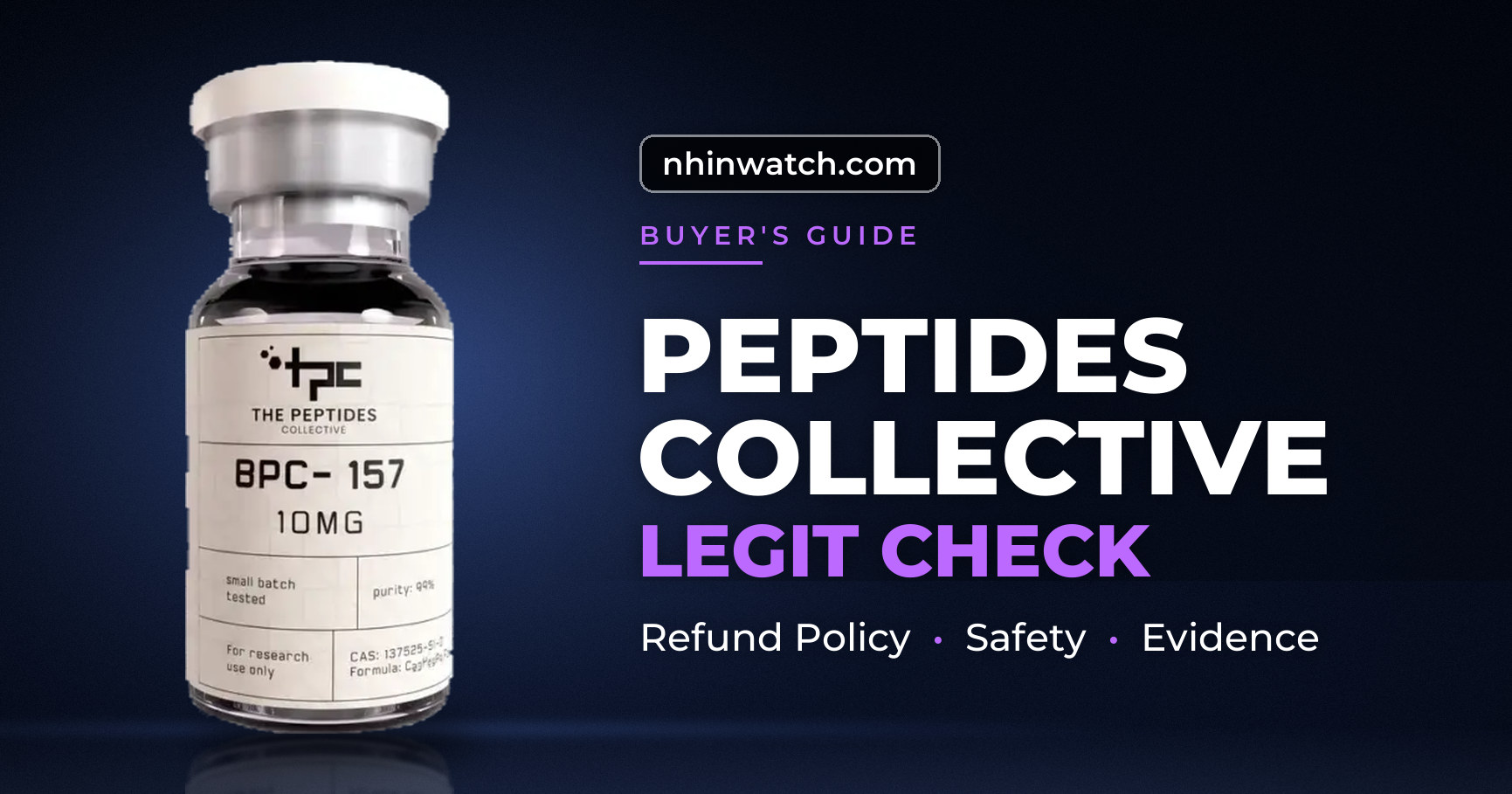
Is Peptides Collective legit?
The seller’s pages name the company as TPC Research LLC, which operates as “The Peptides Collective.” The footer shows “© 2026 TPC Research LLC” and lists the support address support@peptidescollective.com. The seller describes itself as a supplier of “research chemicals for in vitro laboratory research,” and says they are “not drugs, foods, dietary supplements or cosmetics.”
So the company is named and reachable. The open question is the use you have in mind. If you planned to inject these peptides yourself, the seller’s own terms do not cover that purchase.
What does Peptides Collective sell, and who may buy?
The research-use policy says products are sold “exclusively to qualified researchers and licensed laboratories.” It also says products may not be resold, relabeled or repackaged “for human or veterinary use.” The banner on every page reads “For laboratory and research use only. Not for human consumption.”
The catalogue, prices and checkout are visible only after you open a free account. The sign-up asks for a research status (Independent researcher, MD, Research foundation, Research institute or Analytical laboratory) and an organization or institution. It also has a checkbox: “I am 21 or older and a qualified researcher purchasing solely for in vitro laboratory research, not for human or veterinary use.” The seller says that declaration is recorded with your account.
Read that box before you tick it. If you plan to use the peptides on yourself, it does not describe your purchase.
What quality claims does the seller make?
The research-access page lists these claims. Treat them as the seller’s own statements:
- A certificate of analysis for tested lots, “downloadable, lot-matched, third party.”
- Purity “verified by third-party testing,” shown as a percentage “where the lab report states one.”
- Storage at −86 °C before dispatch, and tracked shipping from the United States.
Ask support@peptidescollective.com which lot your order comes from and for that lot’s certificate of analysis before you pay. Check that the lab named on it is the one the seller names.
Does the seller claim these peptides work?
The research-use policy says the products are “not intended to diagnose, treat, cure or prevent any disease.” If the ad you saw made health claims, those claims are not the seller’s stated purpose on its own policy page. Check the ad against that policy before you rely on it.
Do peptides really work?
The Guardian explainer on peptides says academics have noted that “most experimental peptides have little scientific evidence to support the claims being made, and where studies do exist these are often in animals or cells.”
The Guardian reports on a recent review by US researchers of peptides often marketed for musculoskeletal injuries. That review said BPC-157 “demonstrated potential benefits in tendon and muscle repair, but these findings are largely unvalidated in human trials.” For TB-500, the reviewers said there had been no studies in human participants.
Prof Adam Taylor of Lancaster University, quoted in the same Guardian piece, put the gap plainly: “potential benefits in pre-clinical studies – such as those in animals and cells – do not necessarily mean a peptide is beneficial for humans.”
How do you know which peptides are legit?
Peptides approved as medicines are a different category. The Guardian names semaglutide (Wegovy) and tirzepatide (Mounjaro) as approved prescription weight-loss medicines based on synthetic peptides. Many other peptides sold online have not gone through the regulatory process used for medicines. The Guardian describes them as “unregulated, experimental peptides being sold for self-injection.”
On the research label, the UK’s medicines regulator, the MHRA, told the Guardian: “We disregard claims that products are for ‘research purposes’ if it is clear that such claims are being used as an attempt to avoid medicines regulations.” It also said that where medicinal claims are made, “a peptide-containing product must hold a marketing authorisation to be legally sold or supplied in the UK.” The MHRA is the UK regulator, so it does not set US rules, but its position shows how regulators read “research only” wording.
The Guardian also reports that TB-4 and TB-500 are on the World Anti-Doping Authority’s prohibited list. For a peptide you are considering, ask the seller which regulator’s approval, if any, applies to it. For a regulator’s view on peptides in general, see our FDA peptides advisory panel vote guide.
What are the downsides of peptides?
The Guardian’s explainer lists these concerns from experts and researchers:
| Concern | What the Guardian reports |
|---|---|
| Contamination | Taylor said peptides made for research could contain “other ingredients that were dangerous for humans, or bacterial endotoxins. The latter can trigger septic shock.” |
| Hormone balance | Taylor said raising peptide levels by injection “could throw its systems out of balance.” |
| Unexpected effects | Many peptides act in many pathways in the body, so taking them “could have unexpected results.” |
| Medicine interactions | Concerns that peptides could interfere with medicines people are already taking. |
| Self-injection | Risks include “accidentally injecting air.” |
| Monitoring | There is “little, if any, active monitoring of their effects.” |
| Dosing | A review said information on “dosing, frequency and duration of treatment remains unknown.” |
| Tumours | Taylor raised a theoretical concern for some tumours, adding: “There’s absolutely no evidence of this happening at the moment.” |
If you take any medicine, talk to a pharmacist or clinician before you use an injectable.
What does it cost, and is there a recurring charge?
The seller’s research-use policy says “the catalogue, prices and checkout are available only to registered accounts.” Prices and bundles change, so check today’s price directly with the company in the checkout.
Before you pay, look for three things in the checkout: the total with shipping, any bundle you are being pushed into, and any recurring or subscription charge you did not expect.
What are the shipping rules?
The shipping and returns policy lists these facts:
- Free USPS Priority shipping on U.S. orders over $250. Other options are USPS Priority, UPS Ground, UPS 2 Day, and UPS Air Overnight, which you request by email.
- Orders are fulfilled Monday to Friday, excluding federal holidays. Orders before 2:00 PM EST are typically processed the same business day.
- The seller ships only within the United States. The buyer is responsible for confirming the products are legal where they live.
How do refunds and returns work?
The seller’s shipping and returns policy sets these terms:
| Term | What the policy says |
|---|---|
| Window | Within 14 days of confirmed delivery. |
| Eligible returns | Items that arrived damaged, mislabeled or incorrect because of the seller’s error, and that are unopened and unused. |
| How to ask | Email the order number, a photo and a description. All returns need pre-approval and an RMA number. The seller arranges a free reshipment. |
| Not accepted | Buyer’s remorse or accidental purchases; opened, tampered or improperly stored items; purchases for resale or repackaging; and “products suspected of being intended for human or animal use.” |
| Refund timing | To the original payment method within 5-10 business days after receipt and inspection. The same page says elsewhere 10-15 business days to post. |
| Shipping costs | Non-refundable unless the seller erred. |
| Restocking fee | 20% may apply to non-defective returned items. |
| Risk of loss | Passes to you once the carrier marks the package delivered. |
In practice, the refund is for a damaged, wrong or mislabeled order. It is not a refund for changing your mind. The two refund timings on that page conflict, so ask support which one applies to your order.
Who is named or shown in the ad?
The seller’s pages name TPC Research LLC. Check the ad itself for who appears in it or is named, and treat any celebrity name as a claim to check, not a fact. Ads that attach a famous name to a product are a pattern regulators have acted on. In one FTC case, a law-firm summary says the FTC alleged that the defendants hosted fake media sites that falsely claimed celebrities such as Kim Kardashian and Jennifer Aniston had used or endorsed the products, and the case ended in a settlement. That case involved other products, but the tactic is the same. For how these ads are built and how to report them, see our fake news nerve pain cure ads guide.
On Joe Rogan, the Guardian reports that he has alleged BPC-157 and TB-500 help with injury recovery. That is a claim about recovery, not a statement about where he buys anything. Nothing in the reporting here ties him to this seller.
What should you do if you already paid?
- Check whether a return is possible. Email support@peptidescollective.com within 14 days of confirmed delivery, with your order number, a photo and a description. Returns are only accepted for seller error, so if the order was correct, expect no refund.
- Ask about cancellation before the order ships. Send the same email with your order number and ask to cancel.
- Dispute a charge you did not agree to. If you paid by card and the charge is one you did not agree to, contact the company or bank that issued the card. Tell them the charge was fraudulent and ask them to reverse the transaction, as Georgia’s guide to getting money back advises.
- Act quickly. LegalShield’s chargeback guide says you usually have 60 days from when the charge appeared on your statement. For debit cards, it says reporting within 2 days limits your loss to $50, and reporting within 60 days limits it to $500.
- Report it to the FTC. File at the FTC’s ReportFraud site. The FTC says your report “is shared with over 2,000 law enforcers,” but also that “We can’t resolve your individual report.”
Before you order: what to check
- Decide whether the research-only box describes your purchase. If you plan to use the peptides on yourself, the seller’s own terms do not cover that use.
- Ask support@peptidescollective.com for the certificate of analysis for your specific lot.
- Read the checkout total, any bundle, and any recurring charge before you pay.
- Confirm the delivery address is in the United States, since the seller ships only there.
- Check the refund window and the 20% restocking fee in the shipping and returns policy.
- Check the FTC and your state attorney general for any action against TPC Research LLC before you pay. The CFTC’s fraud guidance lists the state attorneys general and other places to check.
- If you are comparing other peptide sellers, our Synthesis Peptides legit check covers the same price, safety and refund questions.
By NHINWatch.com Investigations Desk
This article is for general information purposes only and does not constitute medical advice. Consult your doctor or qualified healthcare provider before making changes to your health routine.